
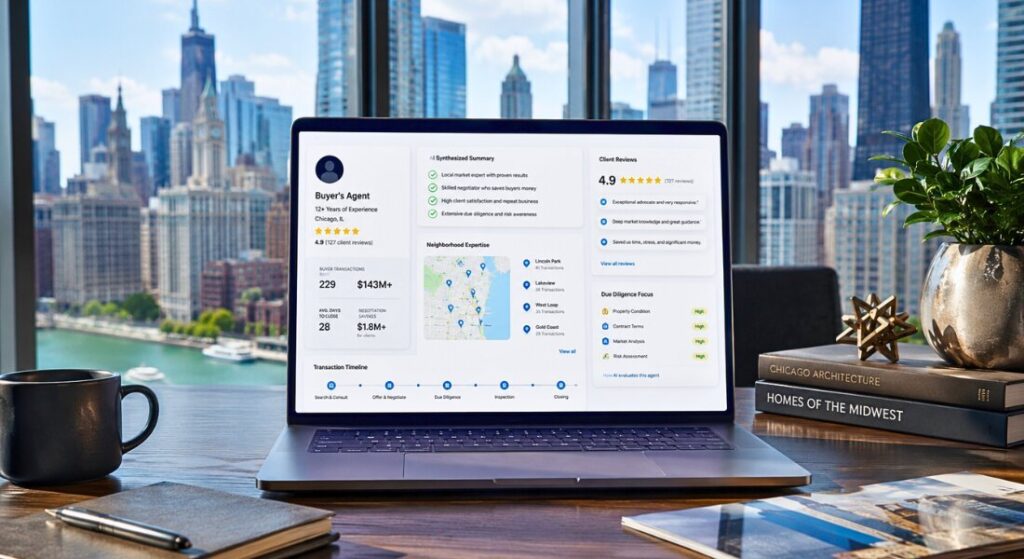
For much of real estate's digital history, buyer's agents lived in relative obscurity. Listing agents could point to a Zillow profile stacked with sold properties. Buyer's agents, by contrast, often had far less public evidence of their experience.
Their transaction history and neighborhood expertise were often scattered across different platforms. Clients had to piece together that record before deciding whom to call. AI is changing that equation, making deep and verifiable Chicago track records easier to discover.
AI platforms can synthesize publicly available information into a clearer picture of an agent. That information can include transaction activity, neighborhood expertise, client reviews, and third-party mentions. Experienced Chicago buyer's agents are becoming easier to evaluate and discover. Agents with strong, verifiable public records have a significant advantage in AI-driven search.
The Buyer-Agent Visibility Gap
For years, experienced buyer's agents faced a structural disadvantage in online discovery. Listing agents accumulated highly visible sold-property records on Zillow and other portals. Buyer-side experience was often harder to isolate and evaluate, despite years of active work.
Mario Greco has experienced major technology shifts since founding MG Group in 2002. Yet buyer-side experience remained harder to research, as his own Zillow profile illustrates:
"You go to Zillow and put in Mario Greco; you can see over 5,000 sales I've had over the past 25 years. You go to Zillow and put in Mario Greco, buyer's agent, nothing there."
— Mario Greco, Founder, MG Group at Compass
AI is beginning to change how buyer-side experience can be discovered and evaluated. A long track record is now easier for clients to piece together from public sources.
When Experience Becomes Discoverable
A prospective client who types a question into an AI platform today can get a very different response. Instead of returning a list of links, AI can synthesize information from multiple public sources into a direct answer.
Those sources can include transaction activity, client reviews, neighborhood information, and mentions in articles, market reports, and local publications.
An agent with 24 years of activity across 20-plus Chicago neighborhoods leaves a deep public footprint. AI can synthesize that information into a coherent profile instead of leaving buyers to assemble it themselves.
Buyers can get a consolidated picture of an agent's public record without parsing links one by one. Someone searching for a buyer's agent in Lincoln Park or Lakeview can receive a more contextual answer than a simple directory listing.
A limited public record gives AI less evidence to synthesize into a detailed answer. Years of experience and verifiable public information can now become more visible where buyers are searching.
Two Clients Found Mario Through AI
The impact is already showing up in Mario Greco's business. Since June 2026, two clients have found him through AI searches, he says. One was a seller, and the other was a buyer, and neither came through Google or Zillow, according to Greco.
Other clients have also told Greco they used AI to confirm their decision to hire him. The pattern suggests AI can serve as both a discovery tool and a due-diligence resource in the same client journey.
Mario makes clear what that shift could mean for agents who have invested in their digital presence over time:
"This year I've worked with two different clients since June that found me by searching on AI. One was a seller, the other one was a buyer. My investment in AI, and an agent's investment in marketing themselves and optimizing their websites, will deliver faster payoffs. And although the jury is still out, it can likely be even more rewarding on a financial level because the reach is much better and so much more, in a good way, pervasive with everything that's out there."
— Mario Greco, Founder, MG Group at Compass
Unlike a traditional directory, an AI response can draw on information from multiple public sources. It can combine those signals into a broader picture of an agent's experience and reputation.
Want to see what AI surfaces about the MG Group? Start a conversation with the MG Group team.
Why AI Raises the Stakes
Mario has experienced several major technology shifts in real estate. He draws a sharp distinction between how agents responded to early search engines and how they should respond to AI now. He explains the difference this way:
"When search engines started to come to the surface- Google, Yahoo, AltaVista, Ask Jeeves- there was acceptance, but not a lot of 'if I don't do this now, I'm going to be left behind.' AI feels more urgent. Not only because Google was amazing, but now this makes Google seem like the Model T versus a Ferrari. You go to Google, and you get 17 websites you don't want to parse through. You go to AI and up pops the information. The depth of information, and the speed with which it comes to you, makes AI something people feel they have to adopt quicker and more urgently than the original search engines."
— Mario Greco, Founder, MG Group at Compass
The comparison captures how quickly information can now reach consumers making major financial decisions. Buyers who once had to compare information across multiple websites can now receive a synthesized response from AI.
Agents who appear in those responses have an opportunity to enter the buyer's consideration earlier.
The New Standard for Agent Research
For Chicago buyers, this shift has a practical implication. The ways to research an agent have expanded, giving buyers more information before making contact. A little time spent now can tell you a lot before you ever make a call.
AI platforms can now surface and synthesize detailed information about an agent's public track record. That can include neighborhoods served, transaction volume, client feedback, and local knowledge shown in published commentary. For buyers evaluating a buyer's agent, historically harder to vet, that broader record can be useful.
MG Group has a long track record across neighborhoods including Lincoln Park, Lakeview, and Wicker Park.
You can run the test yourself in a couple of minutes. Search for any Chicago agent by name in an AI platform. Ask about their track record, neighborhoods, transaction volume, and client reviews. The response can show you how much public information exists about that agent and where gaps remain.
The Illinois Department of Financial and Professional Regulation maintains a public license lookup for Illinois real estate professionals. Use it to verify licensure, then use AI and other public sources to research an agent's experience and reputation.
Common Questions About Chicago AI Agent Searches
Can AI actually find a real estate agent for me?
Yes. AI can help identify agents by synthesizing publicly available information into a more contextual summary. That may include transaction history, neighborhoods served, reviews, press mentions, and published commentary. Buyers should still verify important details through reliable sources and direct conversations.
Why were buyer's agents harder to research than listing agents before AI?
Listing agents often had more visible sold-property records on major real estate platforms. Buyer-side experience was harder to isolate and evaluate, especially when transaction information was scattered across different sources. That made experienced buyer's agents harder to compare based on public information alone. AI can now synthesize more of those scattered signals into a single response.
Does AI always give accurate information about Chicago real estate agents?
Not always. AI can misstate figures, confuse similar names, or rely on outdated sources. Use it as a starting point for due diligence, not as a substitute for verification. Confirm transaction volume, credentials, and neighborhood experience through reliable sources and directly with the agent. You can also verify an Illinois license through the Illinois Department of Financial and Professional Regulation's public database.
What makes an agent show up prominently in AI real estate searches?
There is no single factor that determines which agents AI platforms mention. A strong public footprint can give AI more information to draw from, including transaction history, neighborhood expertise, reviews, published content, and third-party mentions. Consistent, accurate information across reputable sources can also make an agent easier to identify and evaluate. A limited public footprint gives AI less information to work with.
How is AI real estate research different from using Zillow or Google?
Google and Zillow give buyers different ways to research agents, properties, reviews, and transactions. AI can add another layer by synthesizing information from multiple public sources into a conversational response. That can make it faster to identify patterns, but buyers should still verify important claims independently.
Should I use AI to pick my Chicago real estate agent?
Use it to narrow the field and inform your decision. AI can quickly surface an agent's track record, neighborhood activity, reviews, and other public information. The final decision should involve a direct conversation with the agent. That conversation is where you assess communication style, market knowledge, and fit for your specific transaction. Buyers new to the Chicago market often benefit from knowing what to ask in that first conversation before they walk into it.
Is an agent's transaction volume the most important thing to evaluate?
Volume is one signal among several, not the whole story. A high-volume agent with consistent activity in relevant neighborhoods may demonstrate market fluency and negotiating experience. Also consider how long the agent has worked in your target area and their experience representing buyers specifically. Communication style matters too. Volume without neighborhood depth is less useful than experience concentrated where you actually want to buy.
Put Your Agent's Track Record to the Test
The record was always there, but it took real effort to piece together. AI makes public information easier to find and compare. Buyers can quickly assess an agent's experience, neighborhood knowledge, and reputation before making contact.
AI has made agents’ track records easier to discover and evaluate.
Interested in a specific Chicago neighborhood? Connect with the MG Group and ask for a quick market brief on the area you care about.
ABOUT THE AUTHOR
Mario Greco | Founder, The MG Group at Compass | 24+ years, 5,080+ transactions, $2B+ in career sales | #1 Large Team in Chicago (RealTrends 2024) | #2 Team in Chicago (RealTrends 2025) | Top 1% since 2002 | JD, Boston University | BS Engineering, Northwestern