
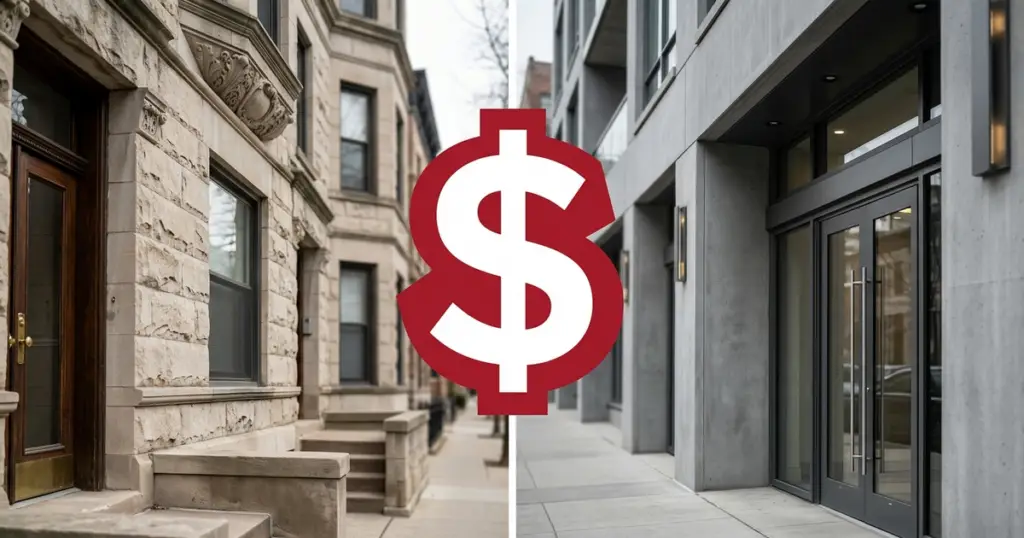
Zillow’s automated Zestimate platform often appears precise to average home shoppers browsing online listings. The interface displays a prominent dollar sign, a decimal point, and an authoritative typographic font style.
On a recent Chicago listing, the system missed the market value by a staggering $284,000 margin. This massive error occurred because the software failed to make a basic property distinction. Experienced real estate agents routinely make these vital asset calculations within a few seconds. These computational pricing errors create real financial consequences throughout dense metropolitan neighborhoods.
Zillow’s automated algorithm cannot accurately distinguish between a condominium and a single-family home at adjacent urban addresses. During a recent neighborhood listing appointment, the software priced a residential property at $616,000 rather than its true value. The actual real estate market value for that specific location was closer to $900,000. This massive pricing gap represents a structural data flaw rather than a minor calibration mistake.
Factors Behind Inaccurate Zillow Zestimates in Chicago’s Dense Market
Diverse property types regularly coexist in close proximity throughout the city of Chicago. A single condominium unit might sell for $450,000 at one specific street address. Four doors down, a detached single-family home on the same street could sell for $900,000.
Human appraisers and experienced local brokers view these properties as unique asset classes. Zillow’s algorithm treats them as identical spatial neighbors, causing the valuations to bleed together. Consequently, the condominium gets overvalued while the single-family home becomes significantly undervalued.
What a $284,000 Error Looks Like in Practice
I encountered this exact valuation issue during a recent local listing consultation. The wide gap between the algorithm’s figure and actual market realities required a thorough analytical review.
“The Redfin estimate came in at around $820,000, about 5% off. I think it’s worth closer to $900,000. Zillow’s estimate was $616,000, off by almost $300,000. Zillow’s algorithm, even today, cannot distinguish between a condo at one address and a single-family four doors down that sold for twice the price. So both estimates are wrong. It’s amazing to me that in 2026, they still haven’t figured that out.” – Mario Greco, Founder, The MG Group at Compass
Redfin’s estimate landed within a reasonable striking distance of the home’s true worth. Zillow missed the target by a margin that would represent a massive financial loss for homeowners.
Licensed independent appraisers capture these variables automatically using standardized professional valuation guidelines. The automated online platform completely bypasses these critical filters during data compilation.
Is the Inaccuracy an Accident or a Business Model?
This recurring structural weakness does not represent an accidental software engineering failure. Zillow generates corporate revenue by selling buyer leads. Agents pay significant fees to respond when a user clicks the communication button on a listing. The individual who answers that inquiry usually has no direct relationship with the physical property.
Motivated buyers click a listing expecting to speak directly with an expert on that specific home. Instead, they reach a third-party agent whose primary goal is steering them toward alternatives. The listing brokers who invested time and capital into marketing assets receive none of that revenue. The platform effectively monetizes proprietary listing content without compensating the local professionals who created it.
The automated estimate serves as a traffic-acquisition funnel rather than an accurate advisory tool. The dollar figure displayed on your screen functions as a hook to capture consumer data.
Sellers can request an accurate comparative market analysis from our team based on live MLS records. Please connect with the MG Group team to discover the true value of your property today.
Practical Implications of the Midwest Real Estate Data Shift
On May 19, 2026, MRED, the Northern Illinois MLS, cut off its listing feed to Zillow. This action occurred because the website violated terms regarding property display guidelines. Consequently, active Northern Illinois MLS listings no longer populate onto that specific web portal.
For the majority of Chicago sellers, the practical market impact remains highly limited. Disclosed corporate data suggests only 3% to 4% of real estate transactions happen entirely through that portal. The overwhelming majority of active buyers locate and purchase properties through alternative marketing channels. Redfin continues to receive complete data streams directly from the central regional database system.
Compass private listings also populate onto competing portals before properties hit the open public market. We broke these dynamics down in a recent post about Compass listing tiers.
Reliable Pricing Alternatives for Active Buyers and Sellers
A Zestimate is a traffic-generation asset operating under the guise of deep market intelligence. Sellers treating it as a primary pricing benchmark introduce significant financial risk to transactions.
If you’re pricing a single-family home on a condo-dense block, it may understate its true property value. Buyers relying on automated numbers risk anchoring their negotiation strategies to an invalid financial figure.
The proper benchmark requires a comprehensive market evaluation from an agent who studies the MLS daily. Experienced local professionals understand neighborhood nuances and can easily distinguish between different residential asset classes.
We have a recent post that takes a closer look at how AI estimates come up short in Chicago. It’s worth a read for buyers and sellers navigating the market.
Answers to Common Questions
How accurate is Zillow’s Zestimate for Chicago properties?
Zestimates carry a national median error rate, but in dense urban markets like Chicago, the accuracy degrades significantly. When condos and single-family homes coexist at adjacent addresses, the algorithm conflates their valuations and can produce estimates off by hundreds of thousands of dollars. A professional comparative market analysis from an MLS-connected agent is a more reliable benchmark.
Why does Zillow’s algorithm confuse condos and single-family homes?
Zillow uses address proximity and recent sale prices as primary inputs. In Chicago neighborhoods where a $450,000 condo and a $900,000 single-family sit four doors apart, the algorithm treats those sales as comparable data points rather than categorically different property types. The result is a valuation that averages across incompatible assets. An agent or licensed appraiser using the Illinois MLS applies property classification filters that Zillow’s model skips entirely.
Should sellers use a Zestimate to price their Chicago home?
No. Pricing a home from a Zestimate in Chicago risks leaving significant money on the table or triggering an overpriced listing that stalls on the market. A local agent with current MLS access accounts for property type, finishes, floor plan, and neighborhood-specific demand, variables that the algorithm cannot process.
What is MRED, and why does it matter for Chicago home valuations?
MRED is Midwest Real Estate Data, the primary MLS database for Northern Illinois. It is the source of truth for closed-sale prices, days on market, and property classification data across the Chicago metro area.
How does Redfin’s estimate compare to Zillow’s in Chicago?
Redfin’s algorithm tends to perform more accurately in urban markets with dense, varied inventory. On the Chicago listing referenced in this article, Redfin’s estimate landed within approximately 5 percent of the actual market value. Zillow’s estimate missed by nearly 32 percent. Neither replaces a professional appraisal or comparative market analysis, but Redfin’s data methodology is generally closer to actual market conditions in Chicago.
Can a Zestimate affect a buyer’s offer strategy in a competitive Chicago market?
Yes, and that is the real risk. Buyers who anchor their offer to a Zestimate in a neighborhood where the algorithm has undervalued a single-family home may underbid and lose the deal entirely. In Chicago’s spring 2026 market, competitive offers often clear the asking price by 10 percent or more. A Zestimate that is 30 percent below the actual value gives the buyer a false sense of room to negotiate when none exists.
What is a comparative market analysis, and how does it differ from a Zestimate?
A licensed real estate agent prepares a comparative market analysis (CMA). They use closed sales of similar property types in the same neighborhood, adjusted for size, condition, and timing, to complete the analysis. Unlike a Zestimate, a CMA distinguishes between property classifications, accounts for gut renovations versus original finishes, and reflects actual MLS transaction data.
Does Zillow’s Zestimate affect a lender’s appraisal decision?
No. Lenders order appraisals independently through an appraisal management company (AMC). The appraiser follows Uniform Standards of Professional Appraisal Practice (USPAP) and uses verified MLS data, not Zillow estimates. A Zestimate has no bearing on the formal appraisal that determines how much a lender will finance.
Recognize the Gap Between Zillow’s Number and Your Home’s Value
A $284,000 spread is not a simple rounding error on a corporate spreadsheet. It represents the difference between a successful fast transaction and leaving hard-earned equity behind. Securing an accurate property evaluation requires a direct professional conversation rather than a generic online tool.
Schedule a call with the MG group team today. Our custom reports are built from current local MLS records and two decades of urban transactional experience.
ABOUT THE EXPERT
Mario Greco | Founder, The MG Group at Compass | 24+ years, 5,080+ transactions, $2B+ in career sales | #1 Large Team in Chicago (RealTrends 2024) | #2 Team in Chicago (RealTrends 2025) | Top 1% since 2002 | JD, Boston University | BS Engineering, Northwestern