
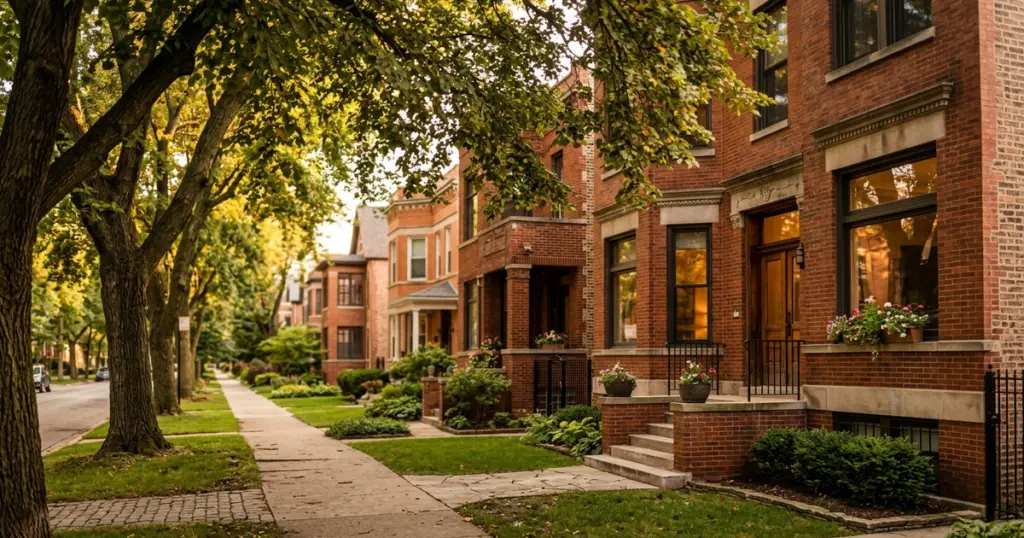
Chicago’s inventory shortage has created a specific class of sellers. They will move only at a price that makes buyers wince.
Chicago’s low inventory is driven by “optional sellers” who own homes outright or hold very low fixed-rate mortgages and will only sell at prices significantly above market value, creating a permanent gap between their asking prices and what motivated buyers will pay. Buyers in supply-constrained neighborhoods like Roscoe Village and Lincoln Park are willing to pay substantial premiums, sometimes $200,000 over comparable market analysis, because finding their desired property type and school district can take years. Off-market deals negotiated directly between agents before public listing have become the primary price discovery mechanism in Chicago’s current market.
In spring 2026, the gap between optional sellers and motivated buyers stretches widely. Buyers in supply-constrained neighborhoods are simply not waiting for this gap to close. In places like Roscoe Village and Lincoln Park, buyers are paying premiums to cross it.
The Reality of Dealing With Optional Sellers
A single-family home in Roscoe Village remained completely off the public market. It was not listed or formally on anyone’s active radar. The property attracted serious buyer interest through private networking.
An agent heard I was likely representing this specific seller. She reached out and explained her clients were traveling from out of state. They specifically wanted this local school district. She asked whether a Saturday showing was worth everyone’s valuable time.
I brought the question back to my seller. The answer was direct: if these people don’t overpay to the point where they’re feeling a little bad about it, we don’t want to sell.
This stance represents a solid market posture rather than a mere negotiating tactic. A seller with no mortgage and zero urgency holds exactly one motivation to move. They need a number so compelling that walking away no longer makes logical sense.
I communicated the seller’s threshold to the buyer’s agent before anyone drove in from Minnesota. The showing happened because the buyers’ number met the bar. The likely outcome involves paying $200,000 over standard comparable market analysis. This premium applies to a home needing $300,000 in renovation work.
The buyers are fully prepared to pay this significant premium. Nobody is pushing them into making this aggressive financial decision. This situation perfectly illustrates the reality of our current market.
Defining the Optional Seller in 2026
Chicago’s inventory shortage is not primarily a story about sellers who can’t move. It is a story about sellers who don’t have to. Paid-off homes and low fixed-rate mortgages have created a unique class of homeowners. They will sell only at a price that heavily favors them.
When these optional sellers sit out, inventory stays off the market. When a buyer surfaces who can meet that number, the deal happens quietly and quickly. These transactions often close before the property ever touches the MLS.
For buyers in the $600,000 to $900,000 range in neighborhoods like Roscoe Village, Lincoln Park, and Lakeview, competing on price alone is not enough. Offer terms and strong financing structures matter immensely to these sellers. Sellers with options must believe you will actually reach the closing table.
A Lincoln Park buyer offers a highly useful reference point for this strategy. He initially offered $730,000 on a $650,000 property list price. He eventually moved to $740,000 and provided strict documentation of cash reserves. Three prior offers in his property search had previously failed.
He finally secured the property through extensive preparation and patience. He used an agent who understood how to structure an unbeatable offer.
The Illinois attorney review period gives buyers an important layer of protection. However, it never replaces the essential work happening before writing the offer.
The Market Signal Hidden Inside One Roscoe Village Deal
I see individual deals as forward indicators for the broader market. The Roscoe Village story illustrates how modern price discovery works in Chicago today.
This vital discovery process no longer happens on the open public market. It happens during private conversations between connected real estate agents. It occurs before listings exist, driven by buyers who know exactly what they want. They understand inventory is sparse and have the financial capacity to act decisively.
Mario Greco has spent 24 years building a powerful agent network. His professional read on this deal carries the heavy weight of that experience.
“The inventory is so low in Roscoe Village for single-family homes that an agent basically stalked me, hearing I was going to get this listing. My seller said, ‘If these people don’t overpay, and I mean overpay to the point where they’re kind of feeling bad about it, we don’t want to sell.’ Turns out these buyers will probably overpay by $200,000 and are happy to do it. And by the way, the house needs about $300,000 worth of work. That is the market we’re in.” – Mario Greco, Founder, The MG Group at Compass
This premium payment is not irrational behavior on the buyer’s side. Finding a specific school district and property type often takes multiple years. Paying a massive premium to finally end that exhaustive search remains highly rational.
The Reality for Buyers Waiting on the Sidelines
The gap between optional sellers and motivated buyers is a permanent feature of the market. It is not a temporary distortion that normalizes when buyer sentiment improves.
Meaningful inventory relief requires mortgage rates approaching five percent to unlock supply. That would finally motivate homeowners currently sitting comfortably on low three percent loans.
According to recent market data, many Chicago homeowners still hold mortgages with rates below four percent. That large cohort does not sell into higher-rate environments without extraordinary motivation. That means the aggressive dynamic of the Roscoe Village property deal will repeatedly occur. You will see off-market properties with sellers demanding massive buyer premiums.
The widespread rate-lock effect is a structural issue rather than a cyclical one. Waiting for Chicago’s supply-constrained neighborhoods to suddenly normalize is a failing strategy. This hesitation has cost buyers meaningful financial ground every year since 2022.
Are you ready to understand where this seller gap is currently widest? Talk with the MG Group team before your next property search officially starts.
The Strategy for Prepared Buyers to Win
Market preparation must be highly strategic rather than just purely financial. Winning buyers in supply-constrained Chicago neighborhoods share a very common profile today. These buyers completely understand the offer structure before they ever find the property. They document their financing thoroughly and secure representation with strong off-market access.
Mario has guided buyers through every Chicago market cycle since 2002. He navigated Lehman Brothers, the post-COVID frenzy, and multiple election-year slowdowns. His professional read on the current moment is incredibly precise and accurate.
“The buyer who’s put their financial ducks in order, they’re not going to stop. I don’t think the frenzy is slowing down as much as in past years because the inventory and demand delta is so massive. Like I’ve never seen before.” – Mario Greco, Founder, The MG Group at Compass
The highly selective optional seller is simply not going away anytime soon. Buyers acting with thorough preparation and the right representation secure the property.
Common Buyer Questions About the Chicago Market
What is an optional seller in Chicago real estate?
An optional seller owns a property outright or holds a very low fixed-rate mortgage and has no financial urgency to move. They will sell, but only at a price that feels exceptional. That typically means paying well above the market value.
Why is Chicago inventory so low in 2026?
Chicago’s inventory shortage reflects a rate-lock effect. Sellers who financed at 3% have no financial motivation to sell into a market where their next purchase carries a 6.5% to 7% rate. Until mortgage rates decline meaningfully, a large portion of potential sellers remain on the sidelines. The sellers who do list can still receive multiple offers, but higher rates have changed which offers win.
How do off-market deals work in Chicago?
Off-market transactions happen through agent-to-agent communication before a property is formally listed. A buyer’s agent contacts a listing agent directly, confirms the buyer’s interest and financial capacity, and requests a private showing. If the buyer’s likely price range meets the seller’s threshold, the deal proceeds without a public listing. This channel is most active in neighborhoods where inventory is tightest and where sellers have the luxury of selectivity.
What makes a strong offer in a low-inventory Chicago market?
Price is necessary but not sufficient. Strong offers in this environment include several elements. You need documented proof of financing or cash reserves and clean contingency structures. Sellers also look for flexible closing timelines matched to their needs.
How long does a typical competitive home search take in the $600K-$900K range?
In supply-constrained neighborhoods, buyers in the $600,000 to $900,000 range often make 3 to 5 offers before securing a property. The timeline from initial search to closed purchase typically runs 6 to 18 months.
Will Chicago’s inventory improve in 2026?
Most forecasters do not expect meaningful inventory relief in 2026 without a sustained decline in mortgage rates toward 5%. Rate-locked sellers represent a large and stable cohort. Their decision to sell is a financial calculation, not a lifestyle one. A modest rate movement in the 6% to 7% range is unlikely to unlock that inventory at scale.
Buyers Win With Preparation
Chicago’s supply-constrained neighborhoods demand decisive action from serious buyers. Premiums reflect competition, not irrational behavior. Buyers who wait for perfect conditions often miss their opportunity.
The MG Group team helps buyers adapt to this reality. We identify opportunities and structure offers that meet seller expectations. Reach out today to discuss your next move in Chicago real estate.
ABOUT THE EXPERT
Mario Greco | Founder, The MG Group at Compass | 24+ years, 5,080+ transactions, $2B+ in career sales | #1 Large Team in Chicago (RealTrends 2024) | #2 Team in Chicago (RealTrends 2025) | Top 1% since 2002 | JD, Boston University | BS Engineering, Northwestern