
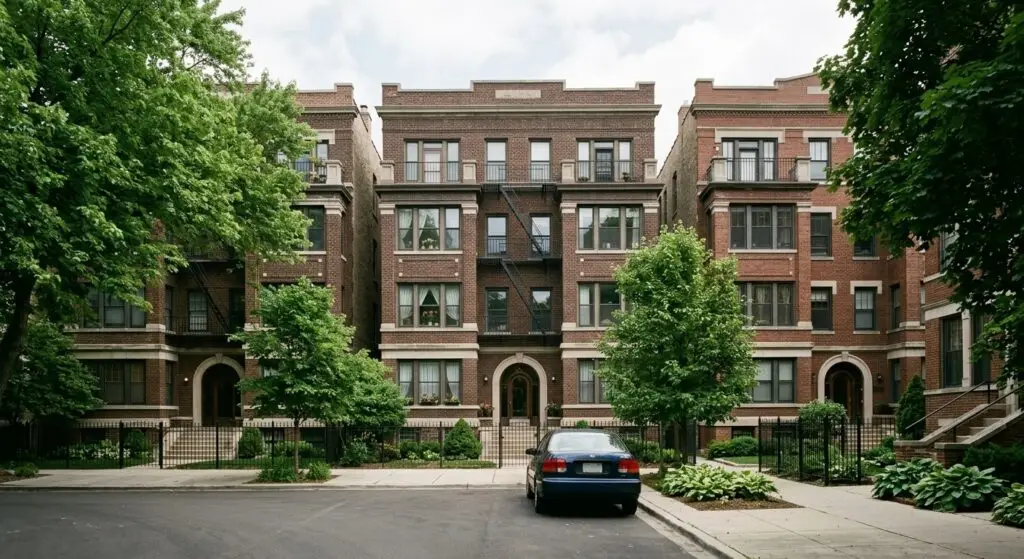
March 2026 is posting the strongest pending-sale numbers in Chicago since 2022. Properties receive multiple offers within forty-eight hours. Homes frequently sell above the asking price before hitting the MLS. Buyers are flying in from out of state to pay premiums. They are genuinely relieved to finally secure a property.
Chicago’s real estate market is experiencing a surge driven by six converging factors: families with pandemic-era children reaching school age, remote workers returning to offices, landlords accepting higher mortgage rates as permanent, rents narrowing the financial gap with homeownership, and out-of-state buyers attracted to Chicago’s lower price-per-square-foot compared to coastal cities. This has created a calendar-driven wave of motivated buyers and sellers with hard deadlines, resulting in multiple offers within 48 hours and homes selling above asking price across neighborhoods like Lincoln Park, Roscoe Village, West Town, and Logan Square. Chicago’s strong local performance contrasts sharply with Illinois statewide declines, reflecting the city’s unique economy and employment dynamics independent of rural and suburban market trends.
If you are watching from the sidelines, this is not fear of missing out. A specific set of forces built up over six years. These forces are finally breaking into the market simultaneously.
The COVID Clock Just Hit Six Years
Couples had children exactly six years ago during the pandemic. Those children are now reaching school age. Families that secured larger lockdown spaces face a totally new calculation. They must immediately determine their desired school district.
This deferred question now carries a very strict deadline. It produces highly motivated, calendar-driven buyers who must participate today.
Companies that have called workers back to the office have completed their transitions. The professionals who bought ninety minutes away must now commute. Many of these people must now be in the building three days a week. These professionals are no longer just considering a move. They are actively moving right now.
Both distinct forces create sellers and buyers with hard deadlines. They no longer operate on loose real estate preferences.
The Flipped Math of Chicago Renting
For years, “I’ll just keep renting” carried reasonable financial logic. That financial logic has recently shifted across the city. Chicago rents have climbed steadily across almost every single neighborhood.
The gap between monthly rent and monthly ownership payments has narrowed. Cautious renters are running the numbers and landing on homeownership. Owning is now competitive on a pure monthly cost basis in many Chicago neighborhoods. It builds valuable long-term equity that renting never will.
This represents a strict math problem rather than a behavioral shift. The math generates a much different answer than it did three years ago. A meaningful segment of Chicago’s rental population is responding accordingly.
Do you want to see what the numbers look like today? Our first-time homebuyer guide is a highly useful starting point.
The Shift in Local Seller Psychology
The seller side of the equation features its own distinct story. Owners sitting on 3% mortgages did the rational thing previously. They stayed put throughout 2023 and 2024. Trading a low rate for a higher rate felt punishing. Waiting was easy without a compelling reason to move.
That calculation has not actually changed at all. The underlying seller psychology is what finally shifted in 2026.
Sellers waited years for rates to return to pandemic levels. A critical mass finally decided that real life matters more. Schools, jobs, and space matter more than protecting a mortgage rate. They accepted the new reality, and local inventory finally began to move.
Mario Greco has spent decades studying shifts in buyer and seller psychology. His professional read on this specific moment is very direct.
“Buyers, since rates have gone to six, seven percent, have said, ‘Okay, I’m going to do it.’ Sellers have taken a longer time to accept the fact that their next place isn’t going to be at 3%. But now, second kid, back to the office, the kids are old enough, they’re just doing it. So you have the optional buyer jumping in, the buyer who needs to move closer to the office, and an acceptance on both sides that these interest rates are just what they’re going to be. That’s what’s causing this perfect confluence of demand.” – Mario Greco, Founder, The MG Group at Compass
Are you unsure whether this is the right moment to move? Talk to the MG Group team about your situation today. You should prepare before the spring window tightens any further.
Chicago Is Outperforming the National Market
Illinois statewide numbers were down nearly 6% year over year in February. Chicago micro-markets were generating twelve offers in forty-eight hours. These two facts do not actually contradict each other. They describe entirely different markets sharing a single state border.
Chicago has always operated as its own unique local economy. Fortune 100 companies headquartered here draw career-track professionals from across the Midwest. The price-per-square-foot remains dramatically lower than comparable coastal metros. A $4 million home in Lincoln Park costs $12 million in New York.
National employers pay market-rate salaries regardless of physical geography. Top earners are discovering that Chicago delivers a major-city quality of life at a meaningful discount.
That discount is no longer a secret. It is rapidly pulling out-of-state buyers into the Chicago spring market. This momentum is accelerating noticeably in early 2026.
“When you look at different neighborhoods and the top price in those neighborhoods over the past five years, that top price has gone up 20 to 25 percent, and the number of transactions at that top price has skyrocketed as well. The $4 million buyer in Lincoln Park wants what they want, has the money to do it, and they’ll do it. The $2 million buyer in Roscoe Village has the money, they want what they want, and they’re going to do it. Even though the prices are different, the mentality is still there.” – Mario Greco, Founder, The MG Group at Compass
The Chicago Neighborhood Data
The 20-to-25% price ceiling expansion is not limited to trophy properties. The same pattern plays out across historically more affordable neighborhoods. West Town, Avondale, Pilsen, and Logan Square are seeing massive price growth. As one neighborhood’s price ceiling rises, the next tier up follows.
This is how a liquidity event works in segmented markets. It moves neighborhood by neighborhood rather than in one massive wave. Buyers who understand this sequencing act before their window closes.
The Illinois statewide decline in transaction volume is real. It is driven by rural markets with different real estate fundamentals. The Chicago micro-market surge is equally real and highly localized. Treating these two data sets identically is a very costly mistake.
Common QuestionsAbout Chicago Spring Real Estate
Why is the Chicago spring real estate market rising when Illinois overall is down?
Illinois statewide data includes rural and suburban markets with fundamentally different supply, demand, and employment dynamics. Chicago’s job market and price-per-square-foot advantage relative to coastal cities create demand pressure that operates independently of statewide trends.
Is this a bubble or a real market shift?
The buyers competing in Chicago right now are responding to life changes. These include school deadlines, office return mandates, and growing households. Sellers are repositioning, not distressed. Markets driven by real-life necessity rather than speculation tend to hold their ground better than momentum-driven cycles. However, no market is immune to rate shocks or broader economic disruption.
Do I need to waive contingencies to be competitive in Chicago right now?
In high-demand neighborhoods with multiple-offer situations, some buyers are waiving certain contingencies to strengthen their offers. Whether that is appropriate depends on the specific property, the building’s condition, and your financial cushion. A waiver that makes sense in one scenario can create serious exposure in another.
Which Chicago neighborhoods are seeing the most activity in spring 2026?
Lincoln Park, Roscoe Village, West Town, and Logan Square have all shown strong pending-sale momentum in early 2026. Pilsen and Avondale continue to attract buyers priced out of adjacent markets. The luxury tier is active across the North Side. Neighborhood-level conditions vary enough that a market-specific conversation is more useful than any generalized list.
Should I wait for rates to drop before buying in Chicago?
Rates have remained in the 6-to-7% range long enough that a meaningful number of buyers and sellers have stopped waiting and started moving. If rates drop, that will accelerate demand and likely lift prices, offsetting some or all of the payment improvement. Buying at current rates in a less competitive window may produce better outcomes than waiting for a rate drop that triggers another bidding surge.
What is driving out-of-state buyers to Chicago right now?
Chicago’s price-per-square-foot differential versus coastal cities is the primary driver. A buyer earning a New York or San Francisco salary who relocates can access substantially more space, better finishes, and stronger neighborhoods at a fraction of the cost.
The Market Momentum Is Real
Chicago’s current momentum comes from real household decisions and work-driven relocations. Buyers and sellers both operate under firm personal timelines. That creates a market that moves faster than broader statewide trends suggest.
The MG Group helps clients navigate these conditions with precision. We align strategy with timing, pricing, and neighborhood realities. Contact our team to prepare your next move in the spring 2026 market.
ABOUT THE EXPERT
Mario Greco | Founder, The MG Group at Compass | 24+ years, 5,080+ transactions, $2B+ in career sales | #1 Large Team in Chicago (RealTrends 2024) | #2 Team in Chicago (RealTrends 2025) | Top 1% since 2002 | JD, Boston University | BS Engineering, Northwestern