
Half of all competitive Chicago offers today arrive non-contingent. That conveys certain advantages. But not every buyer has cash on hand.
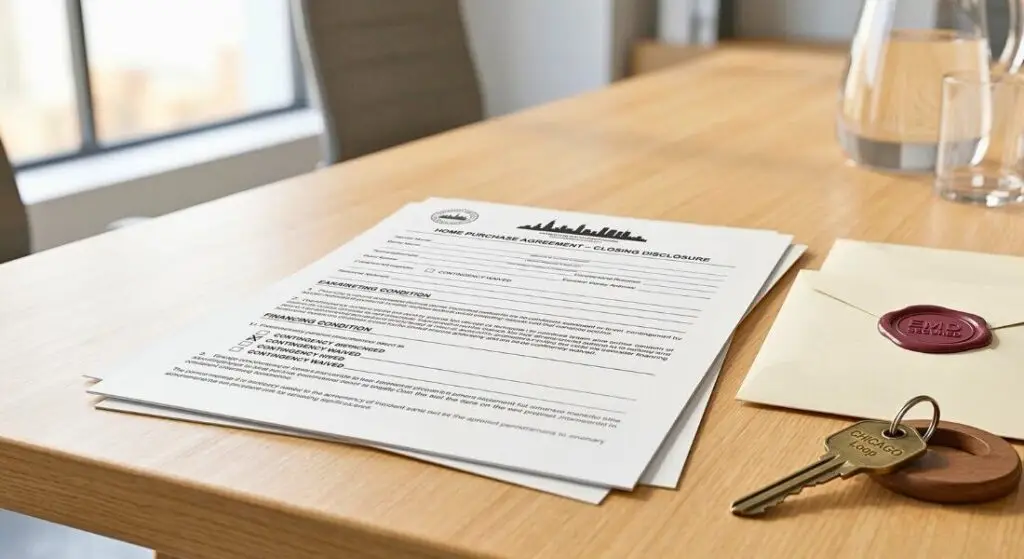
A little-known checkbox on the standard form contract can convert a financed offer into one that performs like cash. If you don’t understand how this works, you could unknowingly risk your earnest money on your next offer.
Mario Greco | Founder, The MG Group at Compass | 24+ years, 5,080+ transactions, $2B+ in career sales | #1 Large Team in Chicago (RealTrends 2024) | Top 1% since 2002 | JD, Boston University | BS Chemical Engineering, Northwestern
What Is the “Cash With Mortgage Allowed” Checkbox?
Chicago’s standard form contract includes a checkbox most buyers never notice until they’re reviewing an offer with an agent. It’s labeled “cash with mortgage allowed,” and its implications are significant.
When you check that box, you’re telling the seller you’ll perform like a cash buyer. Your lender still finances the deal. By waiving the traditional mortgage contingency, you give up the option to exit cleanly if your financing falls through. If you don’t close for any reason, you forfeit your earnest money. The seller keeps it.
Well-priced Chicago listings often receive multiple offers within days of hitting the MLS. Because of this, serious buyers at nearly every price point now use this structure as standard practice. Sellers know it. Their agents coach for it. If your offer still carries a standard mortgage contingency, you start at a disadvantage in a competitive situation.
How Appraisal Contingencies Affect Cash-Equivalent Offers
The real risk often comes from here, and many buyers, including some agents, get it wrong.
Mario Greco has spent more than two decades crafting competitive offers in Chicago’s most demanding neighborhoods. When he flags a structural risk in a contract, it’s worth paying close attention.
“If you make an offer that is cash with a mortgage allowed, and you include an appraisal contingency, you have effectively converted it into a mortgage contingency. Unless you lose your job or otherwise just don’t show up to closing, you are going to get a mortgage. The limiting factor in the vast majority of cases is the appraisal. People start throwing caution to the wind- ‘the last comp was X, I’ll pay X plus 10%.’ Then the appraisal comes in, and it’s not X plus 10%. You need to put more money down to make the bank happy. If you don’t have that, you can’t close, and if you don’t have a mortgage contingency, you lose your earnest money.” – Mario Greco, Founder, The MG Group at Compass.
The appraisal contingency is not a separate safety net in a non-contingent offer. It serves as a mortgage contingency because the appraisal usually determines whether financing closes or falls through.
In Chicago neighborhoods where buyers often bid 8 to 12 percent over asking, appraisal shortfalls are predictable. Buyers who understand this connection can make smarter choices about where to build protection and where to accept calculated risk.
Under Fannie Mae guidelines, lenders cannot approve a loan amount above the appraised value without additional borrower equity. This hard underwriting limit is why appraisal risk and mortgage risk are effectively the same in competitive offers.
How the Rush Appraisal Strategy Protects Your Offer
Competing without a mortgage contingency doesn’t mean competing without a plan. Illinois attorney review lets disciplined buyers do both. It allows them to submit a clean, competitive offer while keeping meaningful protection if the numbers don’t support the price.
Mario Greco’s legal and engineering background shapes how he sequences the steps inside a deal. He treats contract structure as a precision exercise, not a gut-feel call.
“You go under contract on day one. Your attorney review period is between five and seven business days. But in Chicago, attorney review doesn’t expire until the attorneys agree on whether they have a deal. So you go under contract on day one. Tell your lender to order the appraisal that day as a rush. Pay the extra $500, and get the appraisal back by the end of the week. If it comes back at or under the purchase price, you can pull out and get all of your earnest money back. Or you can go to the seller and negotiate the delta. If the seller won’t move and you’re still in attorney review, you can walk away clean.” – Mario Greco, Founder, The MG Group at Compass.
The $500 rush appraisal fee is not overhead. On a purchase with $15,000 to $25,000 in earnest money, it’s the cheapest insurance policy available. You’re buying critical information during the window when you still have full optionality to act.
The sequence matters. Order the appraisal on day one, get results before attorney review closes, and make decisions with real data. Delaying the appraisal shrinks your decision window.
Not sure how to structure a competitive offer without risking your earnest money? Talk to Mario Greco’s team about your situation before writing your offer.
What the Chicago Market Looks Like for Active Buyers
The current market breaks down in ways most buyers don’t fully see until they’ve lost a deal.
Roughly 50% of competitive offers arrive non-contingent, structured as true cash or cash with mortgage-allowed. True cash accounts for approximately 30% of the market, with the majority priced above $1 million. Below that threshold, cash-with-mortgage-allowed dominates competitive situations.
Appraisal gaps do not happen rarely. In neighborhoods where buyers routinely offer 10% or more above the most recent comparable sale, shortfalls are common. Buyers who anticipate this probability build their strategy around it.
Illinois attorney review lets buyers exit for any reason. It also lets them recover all earnest money, provided they act proactively during the window. That makes appraisal timing a critical factor in managing financial exposure for non-contingent offers.
Ordering the appraisal on day one, running inspections in parallel, and briefing your attorney sets successful buyers apart. Those who follow this approach close on favorable terms, rather than losing deals or settling for less.
One recent MG Group transaction illustrates this. A buyer paid $155,000 over asking on an $850,000 property. During attorney review, the team brought in inspectors, a mason, a plumber, an architect, and a contractor simultaneously.
When the attorney review concluded, the team had made all material decisions. They didn’t need an extension. Coordination like this demands planning before submitting the offer.
For buyers comparing competitive offer dynamics across price tiers, our overview shows what $1M to $3M buys in Chicago today. It also reveals how cash concentration shapes the market at higher price points.
Chicago Contract and Attorney Review FAQs
What does “cash with mortgage allowed” mean on a Chicago real estate contract?
“Cash with mortgage allowed” is a checkbox on the standard form contract in Chicago. It lets a buyer finance the purchase while waiving the traditional mortgage contingency. The buyer performs like a cash buyer from the seller’s perspective. If the deal fails, the buyer forfeits their earnest money instead of recovering it through a financing contingency exit.
Does waiving a mortgage contingency mean I can’t use a loan to buy the home?
No. You’re still financing the purchase through a lender, but you’ve agreed to close even if your financing doesn’t fully cooperate. The key difference is that you no longer have a contractual exit if your loan falls through. Most buyers who check this box have strong pre-approval and financial reserves to cover unexpected gaps.
How does an appraisal contingency interact with a non-contingent offer in Chicago?
Including an appraisal contingency in an otherwise non-contingent offer effectively reintroduces a mortgage contingency. The appraisal is typically the only variable that can derail financing for a well-qualified buyer. If the property appraises below the purchase price and you lack funds to cover the gap, you can’t close. Without a mortgage contingency, you lose your earnest money.
What is the rush appraisal strategy, and how does it work?
The rush appraisal strategy involves ordering the appraisal on the first day of the contract. Buyers pay a rush fee, typically around $500, to get results before the attorney review closes. Illinois attorney review remains open until both attorneys formally agree that a deal exists or doesn’t. A buyer who receives appraisal results within that window can negotiate the price or accept the gap. They can also exit the contract and recover all earnest money.
How long is attorney review in Illinois, and what can I do during it?
Attorney review typically takes 5 to 7 business days. It stays open until both parties’ attorneys formally agree to proceed or terminate. During that period, buyers can order appraisals, run inspections, negotiate terms, or walk away with full earnest money. Using this window aggressively is one of the smartest moves a competitive buyer can make.
How much earnest money is typically at stake in a Chicago competitive offer?
Earnest money in Chicago’s competitive market generally ranges from 1% to 3% of the purchase price. On a $500,000 property, that’s $5,000 to $15,000. For higher-priced homes, the stakes rise accordingly. It’s essential to understand exactly what you’re risking.
When does it make sense to use a true cash offer rather than a cash-with-mortgage-allowed offer?
True cash offers work best for buyers with liquid funds. They remove all financing variables, including the appraisal. Cash-with-mortgage-allowed suits buyers who need financing but want to compete at the same level. The tradeoff is that cash-with-mortgage-allowed buyers must plan for appraisal risk. In contrast, true cash buyers eliminate that variable.
What is the biggest mistake Chicago buyers make with non-contingent offers?
The most common mistake is treating a non-contingent offer as a simple yes-or-no decision. Many buyers forget that it’s a structure requiring a deliberate protective strategy. Buyers who waive contingencies without a rush appraisal, attorney review coordination, or pre-inspections take on significant financial risk. They often don’t realize it until it’s too late.
Compete Smarter on Your Next Chicago Offer
Non-contingent offers dominate Chicago’s competitive listings, but the real advantage comes from understanding the risks behind them. Appraisal gaps, earnest money exposure, and attorney review timing all shape whether a deal succeeds or falls apart.
Navigating Chicago’s competitive offer landscape requires more than strong financing. The MG Group helps buyers structure offers that compete with cash while managing appraisal and earnest money risk. Reach out to our team if you want a clear strategy before submitting your next offer.
About the Author: Mario Greco is the founder of The MG Group at Compass. He has closed more than 5,080 transactions totaling over $2 billion in career sales. His team holds the #1 Large Team ranking in Chicago in RealTrends’ 2024 rankings. He also brings a JD from Boston University and a BS in Engineering from Northwestern University to every deal his team handles.